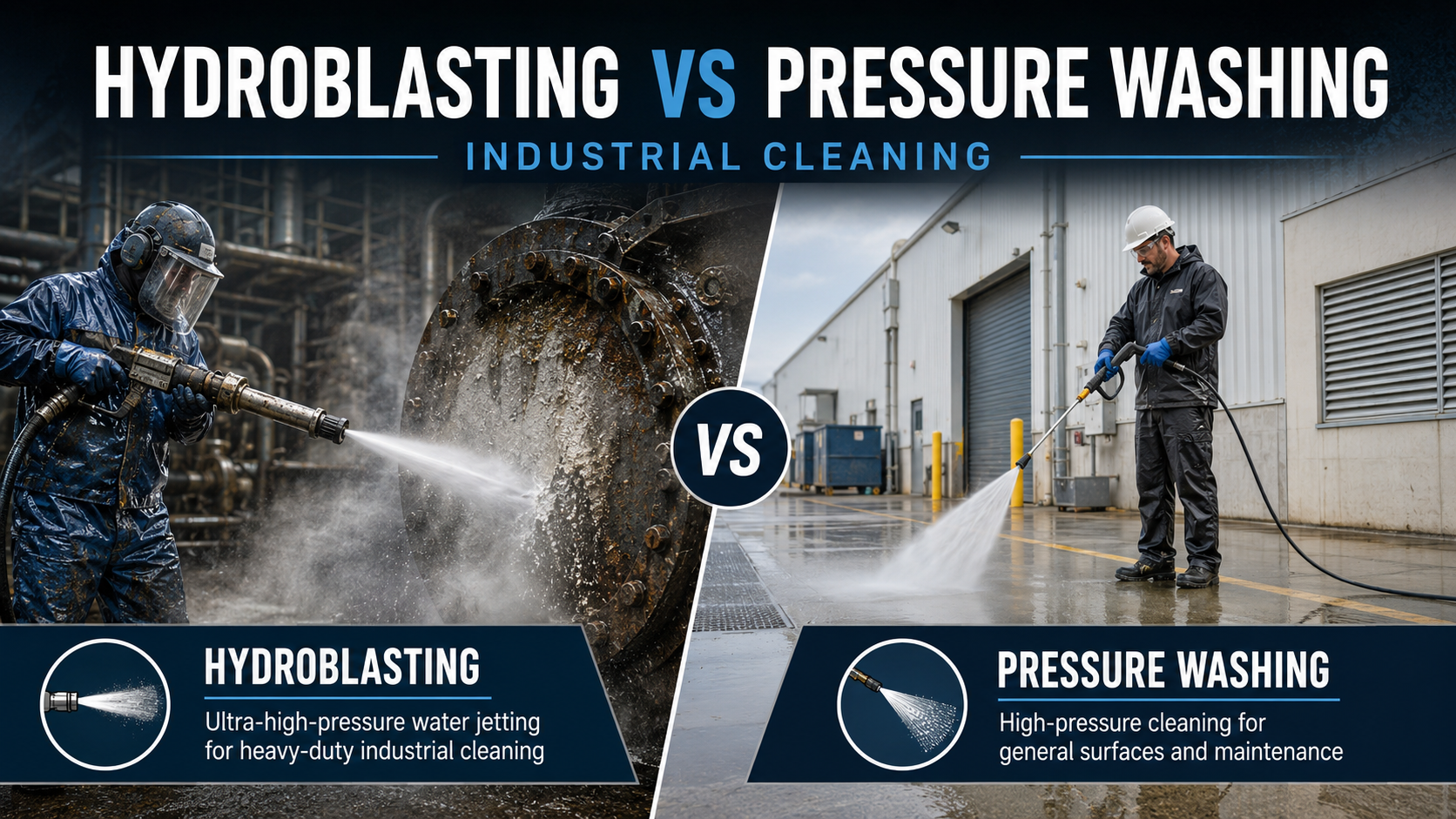
A stained loading area and a factory floor covered with hardened epoxy may both need cleaning. They do not need the same equipment.
Pressure washing works well for many routine exterior jobs. Hydroblasting is built for more demanding industrial removal. Although both methods use water under pressure, the force, equipment, planning, and recovery requirements can be very different.
The material stuck to the surface usually determines which approach makes sense.
Where Pressure Washing Works Well
Pressure washing can remove loose dirt, mud, and surface residue from pavement, walls, loading areas, and building exteriors. It is a practical choice when the goal is general cleaning rather than removing a bonded industrial coating.
Operators still need to consider the condition of the surface. Concrete, masonry, seals, and painted areas can be damaged when the pressure is unsuitable. Water also carries whatever it removes, so drainage and nearby property must be considered.
For straightforward cleaning, conventional pressure washing may be all the job requires.
What Hydroblasting Can Remove
Hydroblasting uses specialized equipment that operates at far greater pressure. Native Environmental has equipment capable of producing up to 40,000 psi for appropriate projects.
That level of force can remove mastic, epoxy, thin set, paint, polymers, and other stubborn material from floors, tanks, buildings, and industrial equipment. It can also prepare a substrate for inspection or the application of a new coating.
Pressure is only one part of the process. Water flow, nozzle selection, distance, angle, and the condition of the underlying surface all affect the result. Trained operators adjust the system according to the material being removed.
Why Recovery Changes The Job
Removing a coating does not make it disappear. The water and debris must be captured, separated, and managed.
Native Environmental uses hydroblasting equipment with water and debris recovery. This allows the removed material to be collected instead of washing uncontrolled across the facility.
Recovery becomes particularly important when the coating contains lead or another regulated substance. Testing may be needed before work starts. Containment, worker protection, packaging, transportation, and disposal can then be planned around the actual material.
Even a nonhazardous coating can create a large volume of residue on an extensive floor or exterior surface.
Consider The Surrounding Facility
Grinding and abrasive blasting can produce airborne dust. Hydroblasting may offer an alternative in data rooms, operational plants, occupied properties, or other locations where dust could interfere with equipment.
Water introduces its own concerns. Electrical systems, active machinery, drainage, access, and adjacent operations must be evaluated. Hydroblasting is not automatically the correct choice simply because a coating is difficult to remove.
A trial area can help determine the likely production rate and condition of the exposed substrate. It may also reveal layers that were not apparent during the first inspection.
Safety Requires Experienced Operators
Water delivered at extreme pressure can cause severe injury and damage. OSHA guidance calls for protective equipment suited to the water pressure and the material being removed. Hearing protection, fall protection, and additional controls may also be required depending on the job.
This is industrial work, not a larger version of cleaning a driveway.
Request Hydroblasting In Arizona
Native Environmental provides hydroblasting for floors, tanks, buildings, parking structures, roadways, process equipment, and industrial facilities across Arizona and New Mexico.
Call Native Environmental at 602 254 0122 to arrange an evaluation of your coating removal or surface cleaning project.
References
Occupational Safety and Health Administration
https://www.osha.gov/etools/shipyard/general-requirements/ppe/ppe-selection/surface-preparation
Native Environmental
https://nativeaz.com/hydroblasting.htm
Native Environmental
https://nativeaz.com/what-is-hydroblasting/